Crime and Punishment
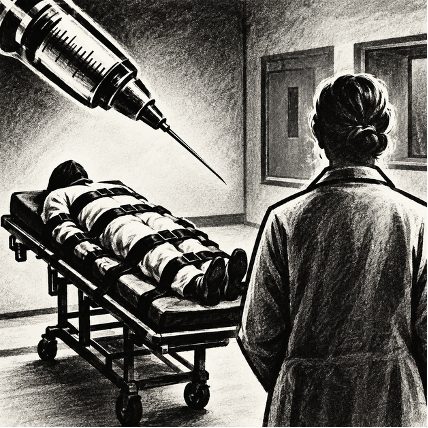
“On September 30, 2026, Tennessee attempted to execute Christa Pike, 50, by lethal injection for the 1995 murder of 19-year-old Colleen Slemmer. The execution went badly wrong: officials administered two doses of pentobarbital, yet Pike did not die. Witnesses reported that she remained breathing—and at times apparently conscious—for more than an hour, complaining of severe pain in her arm. She was eventually taken by ambulance to a hospital, where, according to her attorneys, she remains unconscious, critically ill and on a ventilator. Tennessee officials have said they followed the state’s execution protocol, but Governor Bill Lee has halted all further executions in Tennessee for the remainder of 2026 while the incident is investigated.” (reuters.com)
Why do we punish?
After the recent botched execution in Tennessee, I find myself again mulling over the matter of crime and punishment.
It’s been a topic of interest for me ever since high school and the 1960 execution in California of Caryl Chessman.
I was a high school sophomore, and students were pretty amped up most of execution day.
We were at recess when word was disseminated that Chessman was dead. Cheers erupted, and coursed through hallways, into open doors and out again. A celebratory feel was in the air in what seemed to me a very inappropriate response.
***
I grew up in the 1950s and 1960s when “spanking” children was common. in payment for our misdeeds. My brother and I often committed the same childhood mistakes, so we often received a joint spanking. One for me, one for you.
It hurt, but mostly it was humiliating. When only one of us drew the spanking, the other one was nearby, but never watching. Standing by but not adding to the shame.
Our parents were very controlled as regards spanking, which simply was part of life.
But not all parents were moderate.
America had not yet realized that “spanking” could become criminal, and punishment could become abuse.
Mid-century Moms and Dads were extended a lot of liberty in the parenting arena and, in that freedom, I suppose abuse for some was inevitable.
***
Corrective action has changed in time. We’ve gone through spanking, timeout, limits placed on rewards. Logical or natural consequences. For example, if you’ve TP’d the neighbor’s tree, you might find yourself later picking out every bit of tissue while parents watch. In other words, a punishment that fits the crime.
As a society, the way we construct justice has a lot to say about who we as a people have become.
Is it about retribution? Revenge? Getting even? Is it a payment plan, a punishment, a period of reconstructing the soul before re-entry to society?
And, once we figure that out, what does our thinking suggest about us as a person, a parent, a member of society, a schoolmate, and on and on.
Leave a Reply
You must be logged in to post a comment.