Living These Days

Category: Connections

  • Connections

    A house that’s not a home—and a rock too big to throw

    By Mary Patricia Trainor 

    You know the old saying, “What you see is what you get?”

    As with similar old sayings, this one contains a perfect truth. And a big flaw.

    In my podcast today (link below), I take a look at the Redfield Canyon cliff house.
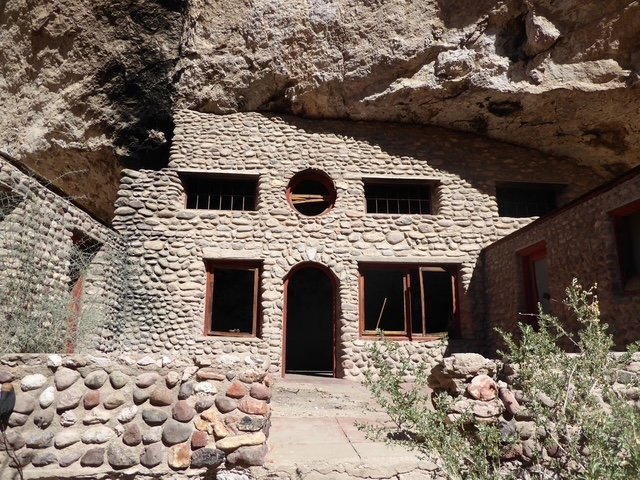
    Its stone facade continues to catch hikers off guard, coming across as what looks like a house built into a Stone Mountain.

    But that’s where “what you see is what you get” misleads us.

    There is no house per se, just that false front, with entry into an area. Which brings to mind another old saying: “There’s more to that than meets the eye.”

    Here are just a couple of interesting points about Arizona’s Redfield House:

    From the canyon it reads like a tiny, weathered stone building pressed up against the cliff — windows, an arched front door, even a low stone patio wall — but most of the living space was actually under the rock overhang rather than as a free standing house.

    It is reminiscent of Giant Rock in Southern California’s Mojave Desert.
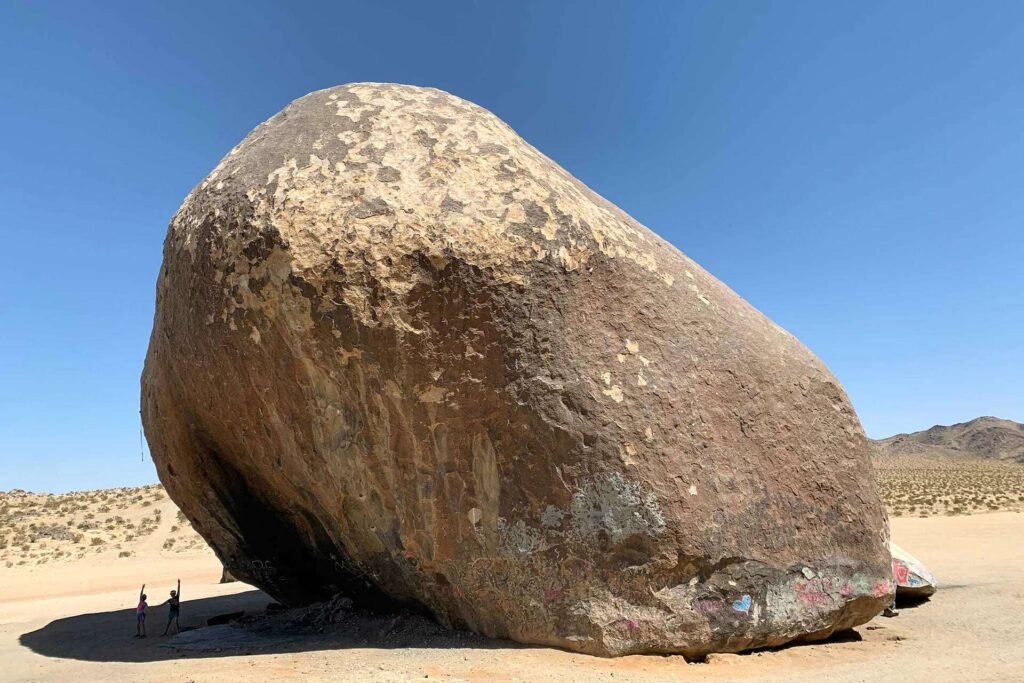
     It is North America’s largest free standing boulder. Some believe it to be the largest such boulder in the world.

    A significant difference between the Arizona Cliff House and Giant Rock is that someone lived 24-7 at the latter.

    Frank Critzer, having observed the burrowing talents of tortoises, himself burrowed under the large rock in the 1930s.

    He realized the tortoises knew something else about burrowing below. The thermal dynamics make desert living doable 

    It was within the confines of his underground home that Critzer died in 1942 in a dynamite explosion he instigated while wanted by law enforcement.

    Back to the Redfield House in Arizona, the stonework and the round window give it a deliberately “made” façade feel, which is why people sometimes think of it as a full-blown residence.

    How did it come to be? Accounts vary. Local writeups and explorers say the little cliff house dates to the 1930s and was built as a private retreat in Redfield Canyon (Galiuro Mountains region) — some name a cowboy/building couple (Chick and Harriet Logan), others attach the name Hope Jones, or tell of a writer who returned from England to build a secluded “mansion” in the canyon.

    In short: It was probably never meant as a conventional year-round home for a big family, more a romantic/solitary retreat built into a cave-like overhang. Or even to be the novelty it is today.

    Over time it’s been vandalized and stripped in places; photos and videos from hikers show broken windows, graffiti, and evidence of people exploring the rooms — which only adds to the mystery and lore.

    The question of “why?” lingers nearly a century later. Here are some thoughts:

    Practically speaking, attaching a stone façade to the cave opening creates a sheltered, weatherproof living face while using the cliff as a roof/thermal mass. It reduces materials you have to bring and gives a clear “front” to the space.

    Also, a faux-house face makes the place feel civilized and photogenic — a deliberate statement, not merely a survival shelter. That mix of function plus image is why it looks like a set piece rather than a simple cabin.

    Thus, the attention given to it just for its looks. 

    Whereas Giant Rock—other than looking like a very big boulder—hides a multitude of stories and myths about the man who lived there for a decade in the last century.

    View podcast (podcast link).

  • Connections

    The Shadow Knows

    Who knows what evil lurks in the hearts of men? The Shadow knows.

    Think of them as a forerunner to podcasts. Before television. Long before we had easy access to a variety of entertainment options. Definitely before podcasts. Before AirPods. Way back then, there was radio.

    And in those glory days, people gathered round to listen to dramas, comedy, music, and so on.

    One of the long-running dramatic radio programs centered around Lamont Cranston as the crime-fighting Shadow, when masked. Unmasked, he was simply another wealthy playboy.

    The serial show began in the early 1930s, and lasted until 1954. In the radio hit, the Shadow worked for justice and right outcomes. Fairness. Truth.

    In the same chronology, but otherwise unrelated, another understanding of Shadow was emerging.

    Swiss psychiatrist Carl Jung developed the way we think about the inner parts of ourselves that limit and sabotage our relationships. He called it our Shadow. An we all have one.

    That’s right, we all have a Shadow side. And, yes, it limits us. Denial doesn’t work for this Shadow. The only way to “win,” if you will, is to meet it head on, and begin what can become a life’s commitment to diluting its negative effects.

    0n the Wonder Files podcast today, my guest is the Rev’d Dr Richard Mallory, who I invited to share about the ManKind Project. Encountering and understanding our Shadow is integral to its work. Check it out here.

  • Connections

    So, what’s the big deal with donkeys?

    Did you know that there is a World Donkey Day? It’s on May 8, and I’m certain there will be much hoopla when that date rolls around again.

    Meanwhile, donkey lovers like me don’t have to wait that long to celebrate these endearing animals.

    If you live near Tucson, Arizona, you’ll soon have a chance to appreciate them up close and personal.

    • 1-3 pm Sunday, December 14
    • Brandi Fenton Memorial Park
    • Free admission.

    And, yes, donkeys will be there to meet and greet.

    We can thank the Human-Animal Connection, and Genie Joseph, its executive director, for this special opportunity. See you there!

    Please see my podcast for more about the donkey and its many charming ways. You also will want to hear a story about a donkey named Lumen.

  • CONNECTIONS

    Do you have the ‘gene’

    The love of animals.

    A friend of mine speaks of the soul-deep, hard-wired love of animals in terms of genetics. “He’s got the gene.” Or, “She doesn’t have the gene.”

    I have the gene (although I reckon there’s no actual gene, but such thinking helps explain the otherwise inexplicable passion for a full range of critters.

    People who like animals, are kindly toward them, but can take them or leave them? They don’t have the gene.

    Awareness of my “gene” started a long time ago.

    When I was a child, I nearly wore the cover off of an over-sized book titled, “Who’s Who in the Zoo,” with a drawing of a chimpanzee gymnastically draped from the black lettering of the title. All of this on an orange-colored hard cover.

    I now have custody of this book again, acquired from a private book seller. It’s like finding an old friend of whom you’ve lost track. I shall not let this old friend get away from me again!

    For my podcast today (link below) I read the Introduction of a relatively new animal book that almost certainly will occupy prominent space in my home. 

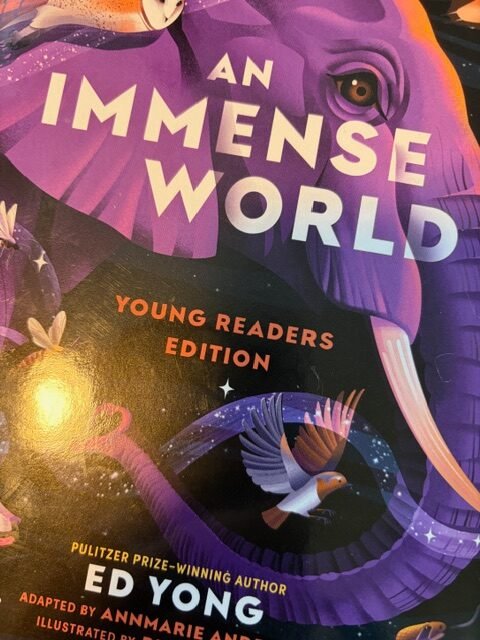
    “An Immense World,” written by Ed Yong, is available in regular, adult, edition, and also in a Young Readers Edition. It is the latter from which I read, for several reasons. A larger font size, plus there is more space between lines that increases readability. Colorful illustrations and highlighted glossary terms add to the fun feel of this book. But make no mistake, there’s plenty of serious and fascinating science to hold your attention.

    In closing, I offer the following poem, author unknown:

    The Quiet Love of Animals 

    They come to us softly,
    on padded paws or beating wings—
    no fanfare, no need for explanations.
    They look at us
    with the kind of knowing that asks for nothing
    but the truth of who we are.
    A dog’s tail writes joy in the air,
    a cat folds itself
    into the warm parentheses of our arms,
    a horse leans its whole weight
    against our loneliness
    just to steady us.

    Birdsong spills into morning
    like a promise,
    and even the shy wild ones—
    the deer at the treeline,
    the fox with the lantern eyes—
    remind us that the world
     still believes in gentleness.

    To love an animal
    is to learn a quieter language,
    to speak in kindness,
    to listen with hands and heart.
    And in their presence
    we remember:

    We are not alone here.
    The earth is shared,
    alive,
      breathing,
      and full of love
     far older and wiser
    than our own.

    Podcast link: An Immense World